
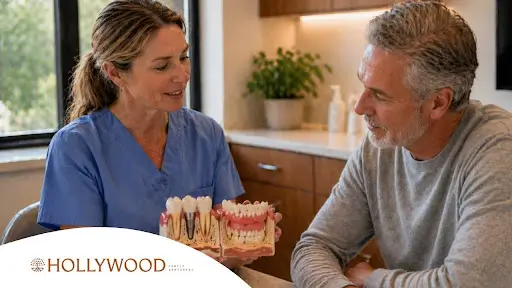
If you are missing teeth, you are probably staring down two very different options and wondering which one will actually make your life better. The truth is, both can. But they solve the problem in completely different ways, and the right choice depends on more than just cost.
This is a dental implants vs dentures comparison written without the usual sales pitch. As a dentist in Portland who fits both every week, I want you to finish this guide knowing exactly which option fits your mouth, your budget, and your lifestyle. Not which one makes me more money.
We will cover how each one works, what they really cost over 20 years, who qualifies for what, and the honest moments when dentures are genuinely the better call.
Key Takeaways
- Dental implants are surgically placed titanium posts that fuse with your jawbone. They last for decades and preserve bone, but cost more upfront and require surgery.
- Dentures are removable prosthetics that sit on your gums. They are faster, more affordable, and work for nearly anyone, but they slip, need replacement every 5 to 10 years, and do not stop bone loss.
- Neither option is universally better. The right choice depends on your jawbone density, overall health, budget timeline, and how much daily maintenance you want to do.
What Are Dental Implants?
A dental implant is a titanium post surgically placed into your jawbone to replace a missing tooth root. Once the bone heals around it, a permanent crown, bridge, or denture attaches on top. Implants look, feel, and function like natural teeth and can last 25 years or longer with proper care.
The keyword is osseointegration. That is the process where your jawbone fuses with the titanium post over 3 to 6 months, creating a biological bond. This is what makes implants so stable and why they preserve bone the way natural roots do.
A single implant replaces one tooth. Two to four implants can support a bridge. Four to six implants can anchor a full-arch restoration like All-on-4. In every case, the implant itself becomes part of your anatomy. You brush it like a real tooth, and it stays put when you eat steak.
What Are Dentures?
Dentures are removable prosthetic teeth that rest on your gums. Full dentures replace an entire upper or lower arch. Partial dentures fill in where some natural teeth remain. They are custom-made to fit your mouth, held in place by suction, clasps, or adhesive, and can be taken out for cleaning.
Modern dentures look far more natural than older versions. The acrylic gum base and ceramic teeth are color-matched to your complexion and the shape of your smile. From across a room, nobody should be able to tell.
That said, dentures sit on top of your gums. They do not integrate with bone. That single difference drives almost every pro and con we are about to walk through.
The three most common types:
• Complete dentures replace all upper or all lower teeth.
• Partial dentures replace a few missing teeth and clasp onto your remaining healthy teeth.
• Immediate dentures are placed on the same day teeth are extracted, so you are never without a smile.
Dental Implants vs Dentures: Side-by-Side Comparison
Here is the honest, no-spin comparison I walk patients through at consultations.
| Feature | Dental Implants | Dentures |
| Upfront cost per tooth | $3,000 to $5,000 | $1,000 to $3,000 per arch |
| Longevity | 25+ years, often lifetime | 5 to 10 years |
| Chewing power | 90-100% of natural teeth | 20-40% of natural teeth |
| Bone preservation | Daily cleaning, soaking, and adhesive | No, bone loss continues |
| Removable | No, permanent | Yes, removed for cleaning |
| Surgery required | Yes | No |
| Healing time | 3 to 6 months | 4 to 8 weeks to adjust |
| Maintenance | Brush and floss like real teeth | Sometimes (upper dentures cover the palate) |
| Affects taste | No | Sometimes (upper dentures cover palate) |
| Risk of slipping | None | Common, especially lower dentures |
| Ideal candidates | Healthy gums, adequate bone | Nearly everyone |
Cost: Upfront, Long-Term, and the Real Math
Most guides give you a single sticker price and stop there. That is misleading. Here is what each option actually costs over 20 years.
Single dental implant over 20 years:
• Initial placement and crown: $4,000 average
• Replacement crown at year 15 (if needed): $1,500
• Total 20-year cost: approximately $5,500
Full denture over 20 years:
• Initial denture: $2,000 average
• Relining every 3 years: $500 x 6 = $3,000
• Replacement every 7 years: $2,000 x 2 = $4,000
• Adhesives over 20 years: $50/year x 20 = $1,000
• Total 20-year cost: approximately $10,000
The gap closes further when you factor in the jawbone preservation implants provide. Bone loss from long-term denture wear can change your facial structure and eventually make new dentures harder to fit, which sometimes leads to additional procedures later.
This is the math I wish every patient saw before they made the decision based on sticker price alone. For a detailed breakdown of what you would actually pay locally, see our guide on dental implants cost in Portland.
Durability and Longevity
Implants win this one decisively. Research published by the National Institute of Dental and Craniofacial Research shows success rates of 90 to 95 percent over 10 years when implants are placed in healthy candidates and maintained well.
Dentures, by contrast, gradually lose their fit as your jawbone shrinks underneath them. Even a well-made denture needs relining every few years and a full replacement every 5 to 10 years. The denture itself does not wear out as fast as the bone underneath it changes shape.
If you are in your 40s, 50s, or 60s, the longevity math favors implants. If you are in your late 70s or 80s, the equation shifts because the 20-year horizon matters less.
Comfort, Chewing, and Daily Life
This is where patients tell me the biggest real-world differences show up.
With implants, you eat what you want. Steak, apples, corn on the cob, all of it. You brush and floss like normal. You do not think about them. Most patients tell me that after a year, they forget which tooth is the implant.
With dentures, the adjustment curve is real. The first weeks involve sore spots, some difficulty eating harder foods, and learning to speak without a slight lisp. Upper dentures cover the roof of your mouth, which reduces taste sensitivity. Many patients adapt beautifully, but almost every denture wearer deals with occasional slipping, especially with the lower denture.
Real-world impact most guides skip:
- Chewing efficiency: Natural teeth produce about 200 to 250 pounds of bite force. Implants deliver 90 to 100 percent of that. Dentures deliver about 20 to 40 pounds.
- Speech: Implants have no effect. Dentures take 4 to 6 weeks to adapt to without slurring.
- Sleep: Dentures come out at night. Implants stay in.
- Intimacy and confidence: Patients report huge differences here. Implants tend to feel invisible. Dentures require ongoing attention.
Not sure which option fits your situation?
Schedule a consultation with Hollywood Family Dentistry, and we will examine your jaw, review your health history, and walk you through both options side by side. No pressure, no sales pitch. Call (503) 281-9612 to book.
Who Qualifies for Each Option?
Honest answer: Not everyone is a candidate for implants.
You may be a good implant candidate if you:
• Have adequate jawbone density (or are willing to do a bone graft first)
• Have healthy gums without active periodontal disease
• Are a non-smoker or committed to quitting before surgery
• Are in generally good health with controlled conditions like diabetes
• Can commit to the 3 to 6 month healing process
Dentures are often the better or only option if you:
• Have significant bone loss, and bone grafting is not feasible
• Have health conditions that make surgery risky
• Are on medications that interfere with bone healing (certain osteoporosis drugs)
• Need a solution immediately and cannot wait 3 to 6 months
• Have a budget that makes implants genuinely out of reach, even with financing
This is the part of the conversation I have with patients every week. Dentures are not a consolation prize. For the right person, they are the right answer. Our guide on tooth replacement options for missing teeth breaks down every alternative if neither fits your situation.
Implant-Supported Dentures: The Hybrid Option
If the full cost of implants feels out of reach but traditional dentures feel like too much of a compromise, there is a middle path many Portland patients choose.
Implant-supported dentures (also called snap-in dentures or overdentures) use 2 to 4 implants per arch to anchor a removable denture in place. You get most of the stability of implants at a fraction of the cost of a full arch of individual implants.
The denture snaps onto the implants and does not slip. Chewing efficiency jumps to 70 to 80 percent. Bone loss slows dramatically because the implants stimulate the jaw. You still remove them at night to clean.
Typical cost ranges from $6,000 to $15,000 per arch, depending on how many implants are used and the denture material. For many patients, this is the practical sweet spot.
Common Mistakes to Avoid
Mistake 1: Choosing based on upfront cost alone.
Dentures win the sticker price fight. Implants usually win the 20-year cost fight. Decide on the timeline that actually matters to you, not just the first number you see.
Mistake 2: Delaying treatment because you cannot decide.
Every month you go without teeth, your jawbone continues to shrink. The longer you wait, the harder implants become later because there is less bone to anchor them. If you are leaning toward implants, waiting can close that door.
Mistake 3: Assuming dentures are “easy.”
They are simpler in some ways. But they require daily care, occasional relines, periodic replacement, and an adjustment period. Go in with realistic expectations.
Mistake 4: Choosing implants to avoid effort.
Implants still require daily brushing, flossing, and regular dental visits. They are not maintenance-free. They are just lower-maintenance than dentures.
Mistake 5: Trusting generic online cost quotes.
Costs vary by region, by case complexity, and by what is actually included. Always get a detailed written estimate from a dentist who has examined your mouth.
Frequently Asked Questions
1. Is it better to get dentures or implants?
It depends on your bone density, health, budget timeline, and how much daily maintenance you want. Implants are better long-term for most healthy candidates. Dentures are better for quick, affordable, non-surgical solutions.
2. What is the downside of dental implants?
Higher upfront cost, surgery required, 3 to 6 months healing time, and not everyone qualifies due to bone loss or health conditions.
3. Can dentures be as good as implants?
Implant-supported dentures come close in stability and chewing power. Traditional dentures do not match implants in longevity, chewing, or bone preservation.
4. What is the cheapest alternative to dental implants?
Traditional dentures are the cheapest upfront. Dental bridges are the middle-ground option when you have healthy teeth on either side of a gap.
5. How painful are dental implants compared to dentures?
Implant surgery causes moderate soreness for 3 to 5 days, managed with OTC pain relievers. Dentures cause sore spots during the first weeks of wear but involve no surgery. See our full post on whether dental implants are painful.
6. Do dentures change the shape of your face?
Yes, over time. Because dentures do not stop bone loss, long-term wearers often experience a sunken facial appearance as the jawbone shrinks.
7. How long do implants last compared to dentures?
Implants last 25 years to a lifetime with good care. Dentures typically need relining every 3 years and full replacement every 5 to 10 years.
8. Are dental implants worth the cost?
For most healthy candidates under 70, yes. The combination of longevity, bone preservation, and quality of life usually outweighs the higher upfront cost.
9. Can you switch from dentures to implants later?
Yes, but it depends on your remaining bone density. The longer you wear dentures, the more bone loss occurs, which can complicate future implant placement.
10. Do implants feel like real teeth?
Most patients say yes, within a few months. They do not have the same nerve sensation, but they function, look, and feel remarkably natural.
Conclusion
When you compare dental implants vs dentures, honestly, neither option is universally better. Implants win on longevity, chewing power, and bone preservation. Dentures win on upfront cost, speed, and accessibility for people who cannot have surgery. Implant-supported dentures split the difference for a lot of Portland patients.
The right choice comes down to four questions. How is your jawbone? What is your overall health? What is your budget timeline? How much daily maintenance do you want?
If you are ready to stop guessing and get a real answer based on your actual mouth, we would love to help you think it through.
Book a tooth replacement consultation with Hollywood Family Dentistry today. Call (503) 281-9612 or visit our contact page to schedule. You can also learn more about Dr. Jaime Holtz and our Portland team and see our real patient smile gallery before your visit. We will give you an honest recommendation, a detailed cost estimate, and the time to decide what is right for you.
