
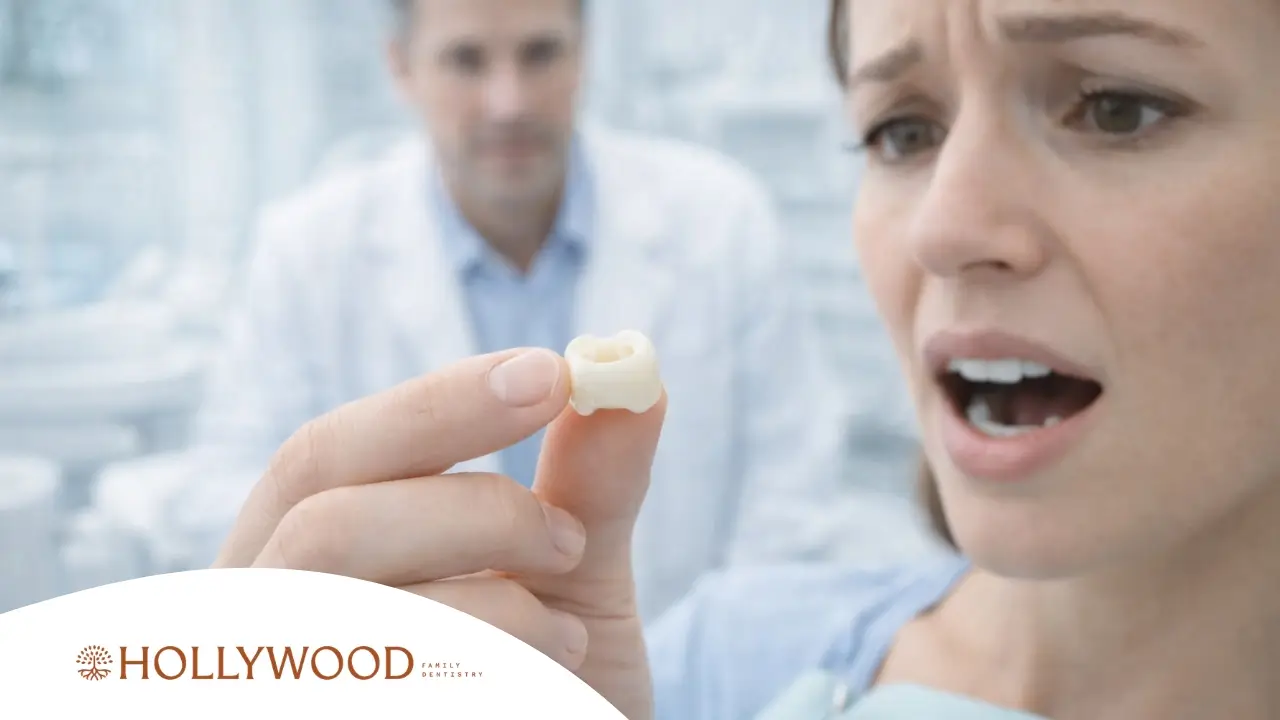
You were eating, biting down on something, or just going about your day when you felt something shift in your mouth. Now you are holding a permanent crown in your hand, wondering what just happened and what to do next. It is a disorienting moment, but it is far more common than most people realize.
A permanent crown falling out does not mean your tooth is ruined. In many cases, the crown can be re-cemented at a same-day dental appointment. What matters most right now is how you respond in the next few hours.
At Hollywood Family Dentistry in Portland, we see this situation regularly, and we know exactly how to help. Here is a clear, step-by-step guide on what to do when your permanent crown falls out.
What to Do Immediately When Your Permanent Crown Falls Out
| Quick Answer: If your permanent crown fell out, retrieve and rinse the crown, avoid chewing on that side, use temporary dental cement from a pharmacy if needed as a short-term measure, and call your dentist the same day. Most dental offices will see you urgently for a fallen crown. Do not use super glue or leave the tooth unprotected. |
The first few minutes after a crown comes out feel alarming, but the tooth itself is not in immediate danger as long as you act sensibly. Here is exactly what to do right away.
Step one is to find the crown and rinse it under warm water. Do not scrub it or use any cleaning products. Place it in a small container or sealed bag so you can bring it to your dental appointment. Your dentist needs to see the crown to assess whether it is re-usable.
Step two is to protect the exposed tooth. Avoid eating or chewing on that side completely. The tooth structure that was underneath the crown has been prepared and shaped, which means it is more fragile and sensitive than a normal tooth. Any pressure on it risks cracking.
Step three is to call your dentist. Do this as soon as possible, ideally within the hour. Explain that your permanent crown has come out. Most dental practices, including Hollywood Family Dentistry in Portland will do their best to fit you in the same day for a fallen crown. It is treated as an urgent situation.
Can You Temporarily Re-Attach the Crown Yourself?
There is one scenario where a short-term home fix is acceptable and one where it absolutely is not. Understanding the difference matters.
Temporary dental cement is available at most pharmacies under brand names like Dentemp or similar products. If you cannot get to a dentist immediately, it is acceptable to use a small amount of this cement to temporarily re-seat the crown. This protects the exposed tooth from sensitivity and minor physical risk while you wait for your appointment. Follow the product instructions carefully.
What is never acceptable is using super glue, household adhesive, nail glue, or any non-dental bonding agent. This is a mistake that dentists encounter more often than they should. Super glue is toxic inside the mouth, it permanently damages the interior of the crown, and it makes proper re-cementation by a dental professional extremely difficult or impossible. It can also bond unevenly and cause bite problems.
Even with pharmacy cement in place, you should still see your dentist as quickly as possible. A temporary fix is exactly that. Temporary.
Can a Permanent Crown Be Re-Cemented?
This is the question every patient asks first. The honest answer is: it depends. There are two main factors your dentist will assess.
The first is the condition of the crown itself. If the crown came out intact with no cracks, chips, or distortion, and if it still fits the prepared tooth properly, re-cementing is often straightforward. Your dentist will clean the inside of the crown and the tooth surface thoroughly, apply fresh permanent cement, and seat the crown back into position. When everything aligns well this appointment takes around 30 to 45 minutes.
The second factor is the condition of the tooth underneath. If the tooth has developed new decay, a crack, or structural damage since the crown was originally placed, simply re-cementing may not be enough. Your dentist will need to address those issues first. In some cases a new crown will need to be fabricated.
X-rays taken at your appointment will give your dentist a full picture of what is happening beneath the surface before any decisions are made.
Why Did the Permanent Crown Fall Out in the First Place?
Permanent crowns are designed to last. When one comes out it is almost always traceable to a specific cause. Understanding why it happened helps prevent a repeat.
Cement failure is the most common reason. Dental cement is durable but not indestructible. Over many years of chewing, exposure to saliva, and temperature cycling, the bond can gradually weaken. Crowns that have been in place for ten or more years are at higher risk of this type of failure.
Decay underneath the crown is another significant cause. When bacteria work their way under the crown margin and cause the tooth structure to break down, the crown loses its foundation and comes loose. This is why regular dental checkups are so important even when a crowned tooth feels completely normal.
Biting down on something very hard, a sudden impact, or grinding teeth at night (bruxism) can also dislodge a crown by putting more mechanical force on it than the cement can withstand. If you grind your teeth and have not yet been fitted for a night guard, it is worth discussing at your next visit.
Sticky foods are a less dramatic but real cause too. Repeated pulling force from caramel, chewing gum, or similar foods can gradually weaken the cement bond over time until the crown eventually gives way.
What Happens If You Leave the Tooth Without a Crown?
Some patients put off calling the dentist after a crown falls out, especially if the tooth is not painful. This is understandable but genuinely risky.
A tooth that has been prepared for a crown had its outer enamel layer significantly reduced. Without the crown protecting it, that tooth is thin and fragile. It can fracture under normal chewing pressure. Temperature sensitivity often develops quickly because the dentin layer is now exposed to everything you eat and drink.
Bacteria can also infiltrate the exposed tooth surface rapidly, causing new decay that may not have been there when the crown first came out. A tooth that could have been saved with a simple re-cement may require a root canal if left exposed long enough.
In severe cases where the tooth cracks beyond repair, the only option becomes extraction followed by a tooth replacement solution such as a dental implant. That is a far longer and more costly path than getting the crown seen to promptly.
According to the American Dental Association, prompt treatment of dental emergencies protects the long-term health and structural integrity of the tooth. Acting within 24 hours of a crown falling out gives the best possible outcomes.
If your permanent crown fell out, contact Hollywood Family Dentistry in Portland today. We will do our best to see you the same day.
What to Expect at Your Emergency Crown Appointment
Knowing what will happen at your appointment removes a lot of the anxiety around calling the dentist in an urgent situation.
When you arrive, your dentist will first examine the tooth and take an X-ray to assess the root, surrounding bone, and any decay that may be present. The crown itself will also be examined for cracks or damage.
If re-cementing is the right path, the tooth and the interior of the crown are cleaned carefully, fresh permanent cement is applied, and the crown is seated and checked for fit. You will be asked to bite down gently to confirm the bite alignment before the cement fully sets. The process is typically completed in 30 to 45 minutes and does not require anesthesia in most cases.
If the crown cannot be reused, impressions or digital scans will be taken and a new permanent crown will be ordered from the lab. A temporary crown will be placed to protect the tooth in the meantime. The new permanent crown is usually ready within one to two weeks.
If the tooth has developed significant decay or damage, additional treatment such as a build-up or root canal may be needed before the new crown can be placed. Your dentist will explain each step and give you a clear treatment plan and timeline before anything begins.
How to Prevent Your Crown From Falling Out Again
Once your crown is back in place, a few consistent habits significantly reduce the likelihood of it happening again.
Avoid hard foods on the crowned tooth whenever possible. Ice, hard candy, crusty bread, and whole nuts put concentrated force directly on the crown and the cement beneath it. This applies to all crowned teeth, not just the one that recently came out.
Sticky foods are equally important to limit. Caramel, chewing gum, and similar foods apply a pulling force that gradually weakens dental cement over repeated exposures. Cutting back on these protects the seal.
If you grind your teeth at night, a custom night guard is one of the best investments you can make for your dental restorations. Bruxism generates enormous pressure over hours of sleep and is one of the leading causes of premature crown failure. Ask your dentist about having one made.
Keep your regular dental checkups. Your dentist can detect early signs of cement failure, margin decay, or crown wear long before they become an emergency. Catching issues at that stage means a simple fix rather than an urgent one.
When a New Crown Is Needed Rather Than Re-Cementation
Not every fallen crown can be put back. There are situations where fabricating a new one is the right clinical decision and it is worth understanding when that applies.
If the crown is cracked, chipped, or has lost its original shape, re-cementing it would produce a poor fit that allows bacteria and food to get underneath. A crown that does not seal properly is worse than no crown at all in some respects.
If significant decay has developed on the tooth beneath the crown, the preparation will need to be rebuilt before a new crown can be seated. Sometimes this is done with a dental build-up material. In cases where the decay has reached the pulp, a root canal is completed first and then the tooth is built up for a new dental crown.
If the crown itself is old and has served its purpose well over many years, a new crown made with current materials and technology may actually be a better outcome than reusing the original. Modern ceramic and zirconia crowns offer excellent aesthetics and durability that older porcelain-fused-to-metal crowns cannot always match.
Dental crowns placed and maintained correctly typically last between ten and fifteen years. If yours has been in place for that long, a new crown is often both expected and welcome.
Quick action checklist for when your permanent crown falls out:
- Find and rinse the crown with warm water and store it safely in a small bag or container.
- Protect the tooth by avoiding food and pressure on that side. Use pharmacy dental cement as a short-term measure only.
- Call your dentist the same day and explain what happened. Most practices will prioritize urgent crown appointments.
- Never use super glue or any household adhesive. This damages the crown and complicates proper dental repair.
Need expert dental crown care in Portland? Contact Hollywood Family Dentistry today and let our experienced team take care of you quickly.
Frequently Asked Questions
What should I do if my permanent crown fell out?
Retrieve and rinse the crown, avoid chewing on that side, use pharmacy dental cement as a short-term measure if needed, and call your dentist the same day for an urgent appointment.
Can a permanent crown be re-cemented?
Yes, if the crown is intact and the tooth underneath is healthy. Your dentist will clean both surfaces and use fresh permanent cement to re-attach it, usually in a single appointment.
Is a fallen permanent crown a dental emergency?
It is an urgent dental situation that needs same-day attention. It is not a hospital emergency, but leaving the tooth unprotected increases the risk of cracking, decay, and sensitivity.
Can I use super glue to fix my crown?
No. Super glue is toxic inside the mouth, permanently damages the crown, and makes proper re-cementation by your dentist very difficult. Only use pharmacy dental cement as a short-term measure.
How long can I wait before seeing a dentist for a fallen crown?
Try to see your dentist within 24 hours. The exposed tooth is fragile and vulnerable to cracking, sensitivity, and bacterial decay. The sooner you are seen the simpler the fix is likely to be.
Why do permanent crowns fall out?
The most common causes are cement failure over time, decay developing underneath the crown margin, biting on hard foods, teeth grinding at night, and repeated pulling force from sticky foods.
